Tel: +256-778-404-397
E-mail: info@kyenjojo.go.ug
In many communities across Kyenjojo District, domestic work, especially cooking, has long been viewed as a woman’s responsibility. Yet, as families evolve and the demand for shared responsibilities grows, the need for more inclusive household roles has become increasingly clear. In a bold effort to redefine traditional gender roles and promote healthier, more balanced households, the Kyenjojo Association of Women Development Actors (KAWODA) is championing a community initiative popularly known as “Men in the Kitchen.”
Though not formally branded under this name, the concept mirrors KAWODA’s household-centered approach, which encourages shared domestic responsibilities, improved nutrition, and gender-inclusive decision-making in families across the district.
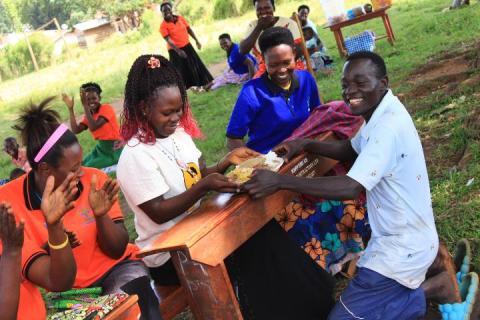
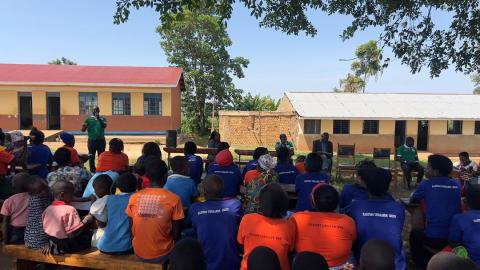
The essence of the “Men in the Kitchen” concept is to encourage men to actively participate in home-based tasks such as cooking, food preparation, child feeding, and nutrition decision-making. This was put into practice at an event held at Kahyoro Primary School, in Kigaraale sub county, where men practiced food preparation, cooking and served their wives and children, replicating what women do in their homes.
For many families, these roles have traditionally been considered exclusively feminine. KAWODA’s approach challenges this stereotype, inviting men into a supportive, nurturing, and culturally shifting space where both parents contribute to the wellbeing of the home.
By promoting shared responsibilities, the initiative helps to reduce the burden of unpaid care work for women, improve family nutrition through joint decision-making, strengthen cooperation between spouses, enhance the dignity and status of women in households, and create an environment where boys grow up seeing domestic work as normal and respectable.
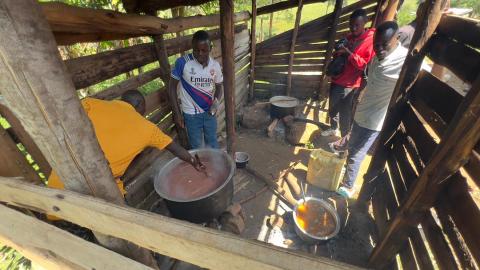
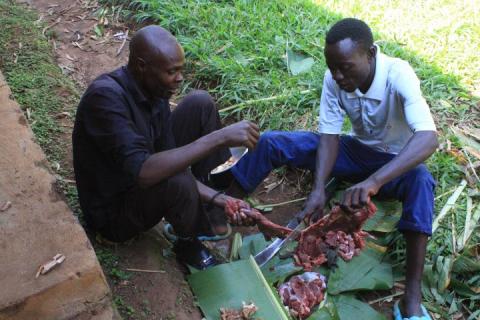
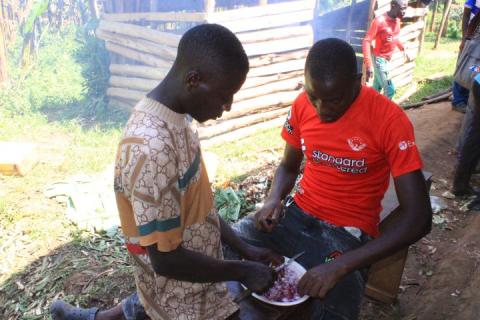
The initiative encourages men to take part in cooking, food preparation, hygiene, and childcare—roles that have traditionally been viewed as the domain of women in many rural households.
According to Ms. Medius Nyabuthono, KAWODA’s Executive Director, the goal is to “promote homes where men and women work together, support each other, and build stronger families.” “Our message is simple,” she said. “Shared responsibilities make households healthier, happier, and more productive. When men participate in the kitchen and in childcare, the entire family benefits.”
KAWODA’s community engagements show that many women in rural households are balancing farming, caregiving, and cooking—often with little support. This heavy workload reduces their time for income-generating activities and limits opportunities for personal growth.

Many families in Kyenjojo are already embracing the shift. At one of the organized events to emphasize the campaign, at Kahyoro Primary School, in Kisengya Parish, Kigaraale sub county, a one Jackson Muhumuza, a farmer, says joining the programme changed his perception of domestic work.
“I used to think cooking was a woman’s job,” he admitted. “But after the trainings, I realized helping at home does not reduce my respect as a man. In fact, my wife and I now work as a team, and our children are healthier.”
His wife, Joyce Katusabe, agrees that the change has been transformative.
“When my husband began helping with cooking and feeding the children, it reduced my workload. I had more time for our garden and even started a small business.”
KAWODA’s approach combines gender awareness with practical nutrition training. Both men and women learn about meal planning, food hygiene, and making healthier dietary choices for their families.
Local leaders have praised the program for contributing to better nutrition outcomes. According to Mr. Ategeka Peterson, the area councilor, “When men become part of nutrition decisions, families eat better. We have seen reduced conflict in homes, improved child feeding practices, and stronger relationships between couples.”
According to Mr. Raymond Nyabongo, the Kyenjojo District Nutritionist, malnutrition remains a significant challenge across several sub-counties, particularly among children under five. “Kyenjojo still faces worrying levels of malnutrition, especially stunting and micronutrient deficiencies among young children,” he noted. “The burden is highest in households where nutrition decisions are left to one person, usually the woman. That is why initiatives like KAWODA’s ‘Men in the Kitchen’ are critical. When men participate in cooking, feeding, and food budgeting, we see better nutrition outcomes, improved child growth, and stronger health-seeking behavior.”

He added that the district is implementing several interventions in partnership with community organizations. “We are strengthening community nutrition education, promoting diverse household food production, and training families on meal planning and food hygiene,” Mr. Nyabongo said. “Encouraging men to be active partners in these efforts is one of the most effective strategies we have for reducing malnutrition in Kyenjojo.”
Ms Annet Masika, the Health Inspector for Butiiti Sub County, Kyenjojo District, emphasized the link between household hygiene, nutrition, and public health. “Many of the nutrition challenges we see in Kyenjojo—especially recurrent diarrheal diseases and poor child growth—are closely tied to hygiene practices at home,” she explained. “When both men and women are involved in food preparation and kitchen hygiene, the standards improve. Families become more conscious of safe water, clean utensils, proper handwashing, and safe food handling.”

She added that collaboration with community organizations is strengthening public health outcomes across the district. “KAWODA’s approach is helping us address the root causes of malnutrition by promoting clean cooking environments, shared responsibilities, and informed decision-making,” This partnership is in the long run critical in reducing preventable illnesses and improving the wellbeing of households in Kyenjojo.
The effort hasn’t been without challenges though. Traditional cultural norms still discourage some men from stepping into the kitchen. However, community champions and role models have helped shift attitudes.
Alfred Basiima, the LC 3 Chairperson Kigaraale Sub County, and a respected local leader, says the initiative aligns with modern expectations for family wellbeing. “Our society is changing. A man helping at home is not a sign of weakness, it is a sign of responsibility. This program is teaching households that love and cooperation are more important than outdated stereotypes.” He also encouraged men to practice what they have learnt at this event, in their homes, if nutrition transformation is to take root in the community.
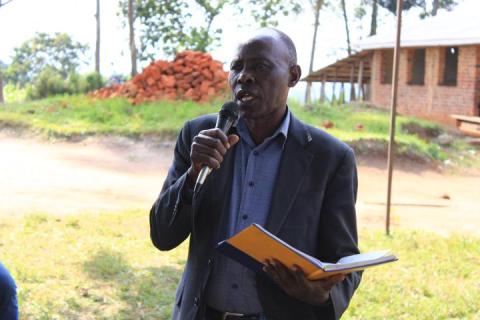
By reducing the burden of unpaid domestic work on women, KAWODA’s “Men in the Kitchen” concept gives women more time for income generation and personal development, contributing to long-term empowerment. KAWODA’s field facilitators note that couples where men participate in domestic roles tend to have better communication, better economic planning, and improved household stability.
The “Men in the Kitchen” idea stands as a symbol of progress. It aligns with Uganda’s broader push for gender-responsive development and reflects the growing appreciation for shared domestic responsibility as a pathway to stronger, healthier families.
Through advocacy, capacity building, and community support, KAWODA continues to spark conversations that challenge outdated norms—inviting men to become active partners in both the field and the kitchen.
The program continues to gain support across Kyenjojo District as communities witness the practical benefits of shared responsibility. As local families embrace the change, KAWODA believes the impact will ripple beyond individual households to strengthen community harmony and economic resilience.